As smart home technology continues to grow, managing multiple devices can become challenging without a centralized system. Smart home hubs solve this problem by acting as the control center for connected devices, allowing them to communicate and work together seamlessly.
Whether you are just starting with a few smart devices or building a fully automated home, smart home hubs provide the structure needed to simplify control, improve compatibility, and enhance overall performance.
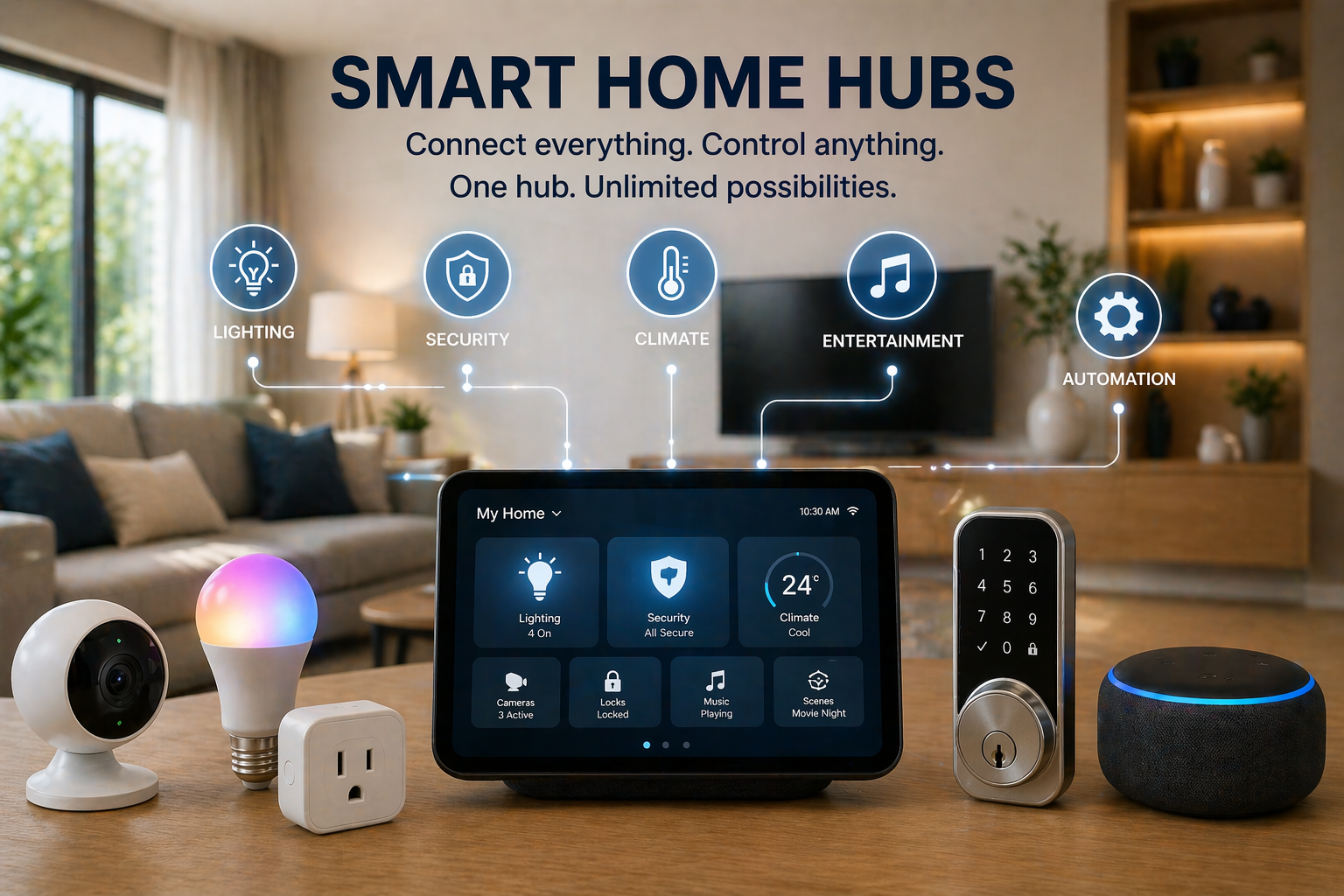
The Smart Home Hubs category plays a critical role in connecting devices across Smart Lighting, Security & Surveillance, Temperature & Climate Control, and Entertainment & Audio.
What Is a Smart Home Hub?
A smart home hub is a device or platform that connects and manages multiple smart devices from a single interface. Instead of controlling each device individually, a hub allows you to create automation routines and manage everything in one place.
Smart home hubs can connect devices that use different communication methods, helping create a more unified and efficient smart home system.
Why Smart Home Hubs Matter
1. Centralized Control
One of the main advantages of a smart home hub is centralized control. Instead of using multiple apps, you can manage lighting, security, climate, and entertainment devices from a single interface.
2. Improved Device Compatibility
Smart home hubs allow devices from different categories to work together, even if they use different communication technologies.
3. Automation and Routines
Hubs enable automation routines, such as turning off lights, adjusting temperature, and locking doors when you leave home.
4. Better Performance and Reliability
By coordinating devices through a central system, hubs can improve overall performance and reduce connectivity issues.
How Smart Home Hubs Work
Smart home hubs act as intermediaries between devices, allowing them to communicate and share information. This communication enables coordinated actions and automation across your entire home.
For example, a hub can trigger Smart Lighting to turn off, activate Security & Surveillance devices, and adjust Temperature & Climate Control settings—all with a single command.
Devices That Benefit from Smart Home Hubs
Smart Lighting
Devices like Smart Bulbs and Smart Light Switches can be grouped and controlled together through a hub.
Security Devices
Smart Cameras, Smart Doorbells, and Smart Locks can be coordinated for enhanced home protection.
Climate Control Devices
Smart Thermostats and Smart Air Conditioners can adjust automatically based on routines.
Entertainment Systems
Devices in Entertainment & Audio can be integrated to create seamless entertainment experiences.
When Do You Need a Smart Home Hub?
Not every smart home setup requires a hub. Many devices work independently using WiFi. However, as your system grows, a hub becomes more valuable for simplifying control and improving coordination.
If you plan to use multiple devices across different categories, a hub can help unify your setup and reduce complexity.
Choosing the Right Smart Home Hub
When selecting a smart home hub, consider compatibility with your existing devices, ease of use, and the level of automation you want to achieve. A hub that supports multiple device types will provide more flexibility as your system expands.
Common Mistakes to Avoid
- Buying a hub that does not support your devices
- Adding too many devices at once
- Overcomplicating automation routines
- Ignoring compatibility when expanding your system
Frequently Asked Questions
Do I need a smart home hub to get started?
No, many smart devices work independently. A hub becomes useful as your system grows.
Can a hub connect different types of devices?
Yes, smart home hubs are designed to connect and coordinate multiple device types.
Are smart home hubs difficult to use?
Most modern hubs are designed with user-friendly interfaces and simple setup processes.
Is a smart home hub worth it?
For larger or more complex setups, a hub can significantly improve convenience and control.
Smart home hubs play a key role in creating a connected and efficient smart home. By centralizing control and enabling automation, they allow devices to work together seamlessly, improving both convenience and overall performance.